

Choosing the right face sunscreen isn't just about finding the highest SPF. It's also about finding a formula that feels comfortable on your skin, works with your daily skincare routine and provides reliable protection against ultraviolet (UV) radiation.
In Australia and New Zealand, where UV radiation can reach particularly high levels, choosing a sunscreen you'll feel comfortable wearing regularly is an important part of protecting your skin.
But with so many formulations available, how do you know which one is right for you?
The best face sunscreen for your skin type is one that provides effective broad-spectrum protection and feels comfortable enough for you to apply generously and consistently.
Dry skin may benefit from a moisturising formula, while oily skin may feel more comfortable with a lightweight or matte finish. People with sensitive skin may need to pay particular attention to ingredients and their individual tolerance.
In this guide, we'll explain what to look for when choosing sunscreen for normal, dry, oily, combination and sensitive skin, with advice relevant to conditions in both Australia and New Zealand.
Sun protection reminder: Sunscreen is only one part of effective sun protection. Avoid prolonged high-risk sun exposure, seek shade and wear protective clothing, a hat and sunglasses. Apply sunscreen generously and reapply frequently according to the label directions.
Why is facial sunscreen important in Australia and New Zealand?
Australia and New Zealand both experience high levels of UV radiation, which can damage your skin even when the weather doesn't feel particularly hot.
Unlike the warmth of sunlight, UV radiation cannot be felt. Your skin can be exposed to damaging UV rays even on cool or cloudy days.
Two types of UV radiation are particularly relevant to your skin:
- UVA radiation penetrates deeper into the skin and contributes to premature skin ageing, pigmentation changes and skin cancer.
- UVB radiation is a major cause of sunburn and also contributes to skin cancer.
A broad-spectrum sunscreen is designed to protect against both UVA and UVB radiation.
Sun protection in Australia
Australia also experiences high levels of UV radiation, but the patterns vary considerably depending on location.
In northern parts of Australia, UV levels can remain high throughout the year. Further south, such as in Melbourne or Tasmania, UV levels tend to be lower during winter.
According to Cancer Council Australia, sun protection is recommended whenever the UV Index reaches 3 or above.
Cancer Council recommends choosing a broad-spectrum, water-resistant sunscreen with SPF50 or SPF50+.
Sun protection in New Zealand
New Zealand experiences particularly high UV levels during spring and summer.
According to SunSmart New Zealand, sun protection is especially important between September and April, particularly between 10 am and 4 pm.
However, protection can also be necessary at other times of year, especially in the mountains, around reflective surfaces or whenever the UV Index reaches 3 or above.
SunSmart recommends choosing a broad-spectrum, water-resistant sunscreen with at least SPF30.
What does this mean for your daily routine?
Whether you're in Sydney, Melbourne, Brisbane, Auckland, or elsewhere, the most practical approach is to check your local UV forecast rather than relying on temperature or cloud cover.
And remember that sunscreen should be combined with shade, protective clothing, a broad-brimmed hat and sunglasses.
Understanding your skin type
Before choosing a face sunscreen, it helps to understand how your skin naturally behaves.
Different skin types can respond differently to the texture and finish of a sunscreen. Someone with dry skin may enjoy a rich, moisturising formula, while someone with oily skin might prefer a lighter product that leaves less shine.
| Skin type | Common characteristics | Sunscreen preferences to consider |
|---|---|---|
| Normal | Generally balanced, without persistent dryness or excessive oiliness | Comfortable lotions or creams according to personal preference |
| Dry | May feel tight, rough or flaky, particularly after cleansing | Moisturising creams or lotions |
| Oily | Produces excess sebum, often causing noticeable shine | Lightweight, non-greasy or matte finishes |
| Combination | Oilier around the forehead, nose and chin, with normal or drier cheeks | Balanced hydration and a comfortable finish |
| Sensitive | May experience redness, stinging or irritation from certain products | Well-tolerated formulations without known personal irritants |
It's worth remembering that sensitive skin isn't necessarily a separate skin type. You can have dry and sensitive skin, oily and sensitive skin, or any other combination.
Similarly, acne-prone skin is a skin concern that can occur alongside different skin types.
Understanding these characteristics can help you choose a sunscreen that feels comfortable throughout the day.
What is the best face sunscreen for dry skin?
If your skin often feels tight, rough or flaky, a moisturising sunscreen may be particularly appealing.
Dry skin can benefit from formulations that provide hydration and help maintain a comfortable skin barrier.
Cream-based sunscreens and moisturising lotions are often good options, particularly if your skin tends to feel dry after cleansing or exposure to wind and cooler weather.
Look for a formulation that spreads easily, feels comfortable and doesn't leave your skin feeling tight.
Moisturising ingredients such as humectants and emollients can help attract moisture and soften the skin.
A sunscreen with a hydrating finish may even provide enough moisture to replace a separate morning moisturiser, depending on your skin's needs.
For dry skin, a moisturising sunscreen can offer the combination of UV protection and comfort that makes regular application easier.
What is the best face sunscreen for oily skin?
Oily skin naturally produces more sebum, which can lead to noticeable shine, particularly around the forehead, nose and chin.
If you have oily skin, you may prefer sunscreen with a lightweight texture and a less shiny finish.
Fluid, gel or lightweight lotion formulations are often popular choices. If you're also prone to breakouts, you may want to consider products labelled non-comedogenic, meaning they are formulated to minimise the likelihood of blocking pores.
However, there's an important distinction between oiliness and hydration.
Oily skin can still be dehydrated and can benefit from moisturising ingredients.
A moisturising sunscreen isn't automatically unsuitable for oily skin, and providing additional hydration does not necessarily increase the skin's natural oil production.
The main consideration is how the product feels and looks once applied.
For example, a sunscreen with a rich, moisturising finish may feel comfortable on someone with mildly oily skin, but less appealing to someone whose skin becomes very shiny throughout the day.
If you have particularly oily skin, a lightweight or matte sunscreen may be more enjoyable to use consistently.
What is the best face sunscreen for combination skin?
Combination skin can be challenging because different areas of your face have different needs.
Your forehead, nose and chin, commonly called the T-zone, may become oily during the day, while your cheeks remain normal or dry.
The goal is to find a sunscreen that feels comfortable across these different areas.
A moisturising lotion may work well if your cheeks tend to feel dry, while a lighter formulation may be preferable if your T-zone becomes particularly shiny.
There is no requirement to use different sunscreens on different parts of your face. Many people with combination skin find one well-chosen formulation perfectly comfortable.
If you're using a rich moisturiser beneath your sunscreen, you may also find that adjusting your morning skincare routine helps achieve your preferred finish.
However, don't reduce the amount of sunscreen you apply simply to avoid shine. Applying enough product is essential for achieving the protection stated on the label.
For combination skin, look for a balance between comfortable hydration and the finish you prefer.
What is the best face sunscreen for normal skin?
Normal skin generally has a balanced level of moisture and oil, without persistent dryness or excessive shine.
This often gives you greater flexibility when choosing sunscreen.
You may enjoy a lightweight fluid, a moisturising lotion or a richer cream, depending on your preferences and skincare routine.
If you prefer a fresh, less noticeable finish beneath makeup, a lighter formulation might appeal to you.
If you enjoy a more moisturised, radiant appearance, a richer sunscreen may be a better match.
The most important factors remain effective broad-spectrum protection, appropriate SPF and a texture that encourages regular use.
For normal skin, personal preference can play a significant role in choosing the right sunscreen.
What is the best face sunscreen for sensitive skin?
Sensitive skin may react to certain skincare products, causing stinging, redness, itching or irritation.
When choosing sunscreen for sensitive skin, it's important to consider the overall formulation rather than assuming that one particular ingredient or type of sunscreen will suit everyone.
Some people with sensitive skin prefer mineral sunscreens containing zinc oxide or titanium dioxide. These may be particularly useful for individuals who react to certain chemical UV filters.
However, chemical sunscreens are not automatically unsuitable for sensitive skin. Many people tolerate them comfortably.
Reactions can sometimes be caused by fragrances, preservatives or other ingredients rather than the active UV filters themselves.
The best approach is to choose a formulation intended for your needs, check for known allergens and pay attention to how your skin responds.
If your skin is particularly reactive, consider testing a small area first. If you have previously experienced an allergic reaction to sunscreen, a dermatologist or other healthcare professional can help identify which ingredients to avoid.
The best sunscreen for sensitive skin is one that provides effective protection without causing irritation or an allergic reaction.
Mineral versus chemical sunscreen: what's the difference?
When shopping for sunscreen in Australia or New Zealand, you'll often see products described as mineral, chemical or physical.
These terms refer to the types of UV filters used in the formulation.
Mineral sunscreens
Mineral sunscreens typically contain zinc oxide, titanium dioxide or a combination of both.
These ingredients provide UV protection primarily by absorbing UV radiation, although they can also reflect or scatter some light.
Mineral sunscreens may be preferred by people with sensitivities to particular chemical UV filters.
Some mineral formulations can leave a visible white cast, although modern formulations vary considerably in their appearance and texture.
Chemical sunscreens
Chemical sunscreens contain organic UV filters that absorb UV radiation.
Different filters protect against different parts of the UV spectrum, so formulations commonly combine several ingredients to achieve broad-spectrum protection.
Chemical sunscreens are often available in lightweight lotions or transparent formulations designed to leave little or no visible white cast.
Which is better?
Neither category is universally better.
A properly formulated and tested mineral or chemical sunscreen can provide effective broad-spectrum protection.
The best choice depends on the product's protection rating, its overall formulation, your skin's individual tolerance and how comfortable you find it to wear.
For more information about sunscreen ingredients and skin compatibility, see DermNet's overview of sunscreen agents.
What should you look for when buying face sunscreen in Australia or New Zealand?
Regardless of your skin type, there are several features worth checking when choosing a sunscreen.
1. Broad-spectrum protection
Look for sunscreen clearly labelled as broad-spectrum, meaning it provides protection against both UVA and UVB radiation.
2. An appropriate SPF rating
SunSmart New Zealand recommends at least SPF30, while Cancer Council Australia recommends SPF50 or SPF50+.
Higher SPF provides greater UVB protection when used correctly, but no sunscreen blocks all UV radiation.
3. Water resistance
Water-resistant sunscreen is particularly important if you'll be swimming, exercising or spending extended periods outdoors.
Water resistance doesn't eliminate the need for reapplication. Even a sunscreen labelled as four-hour water-resistant should still be reapplied at least every two hours outdoors, and after swimming, sweating or towel drying.
4. A comfortable finish
Sunscreen texture matters because it influences how much you enjoy using the product.
Dry skin may feel more comfortable with a moisturising finish, while particularly oily skin may prefer something lightweight or matte.
There's no single formulation that everyone will prefer.
5. Clear directions and trustworthy product information
Look for appropriately tested sunscreen with clear SPF, broad-spectrum and water-resistance information.
Sunscreen products sold in Australia and New Zealand are subject to applicable testing, labelling and product-safety requirements.
In Australia, therapeutic sunscreens can be identified by an AUST L or AUST R number on their packaging, which can be checked against the Australian Register of Therapeutic Goods.
Always read the label, follow the directions for use and check the expiry date before applying sunscreen.
How much sunscreen should you apply to your face?
Even a high-SPF sunscreen may provide less protection than expected if you don't apply enough.
Guidance from both Cancer Council Australia and SunSmart New Zealand recommends approximately one teaspoon of sunscreen for the face, ears and neck combined for an average-sized adult.
For effective protection:
- Apply sunscreen generously and evenly to clean, dry skin, following the product's label directions.
- Apply approximately 20 minutes before going outdoors.
- Reapply at least every two hours while outdoors.
- Reapply after swimming, sweating or towel drying.
- Use sunscreen alongside shade, protective clothing, a broad-brimmed hat and sunglasses.
If you wear makeup, allow your sunscreen to settle before applying it.
When reapplication is needed, make sure you're applying sufficient sunscreen rather than relying on a very light touch-up.
Using the right quantity is just as important as selecting the right SPF.
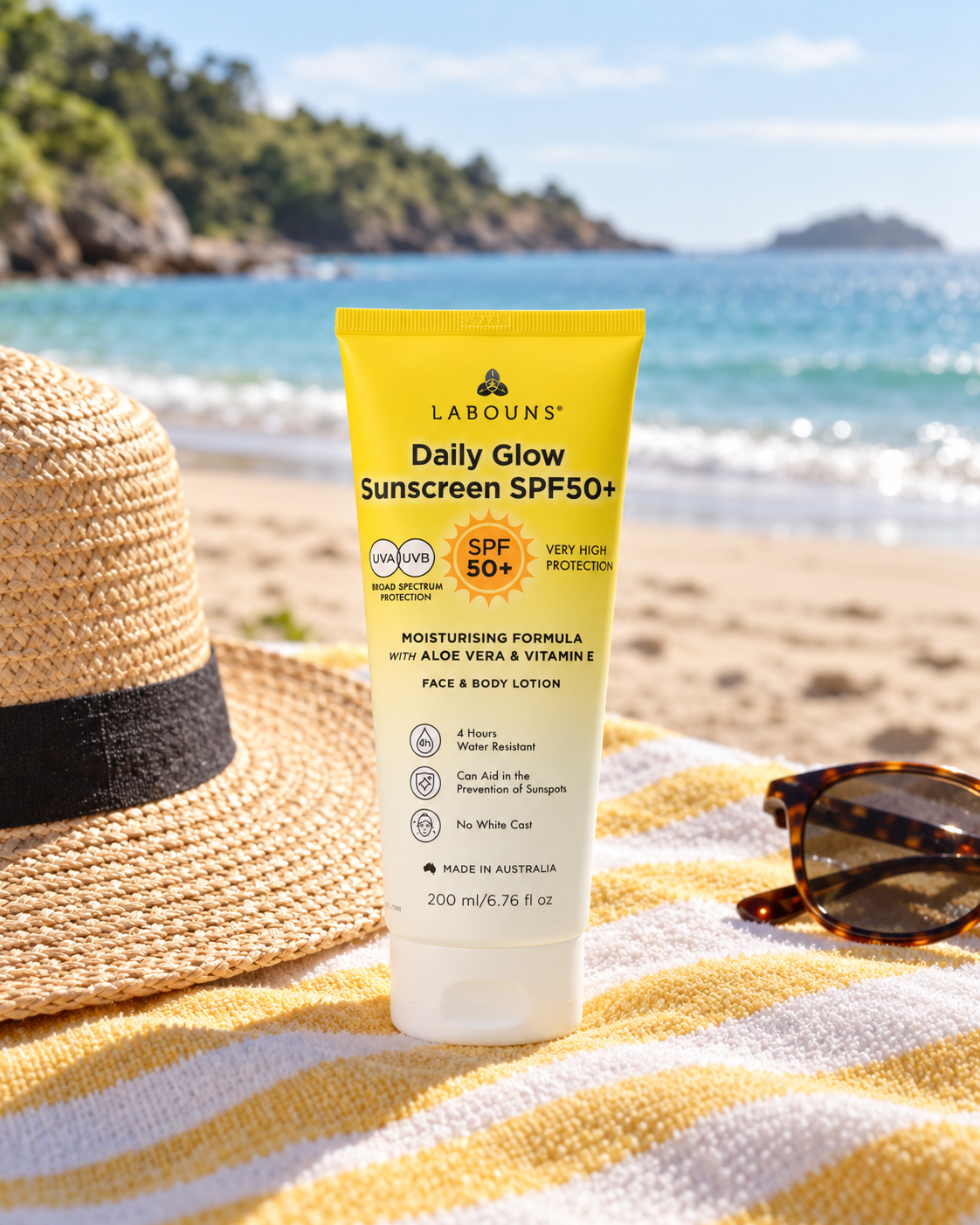
Where does Labouns Daily Glow Sunscreen SPF50+ fit?
Labouns Daily Glow Sunscreen SPF50+ is an Australian-made sunscreen designed for everyday face and body use.
Its formula has a rich, moisturising finish and contains aloe vera and vitamin E.
Daily Glow is formulated for all skin types, including normal, dry, combination, oily and sensitive skin.
However, its finish may appeal to some skin types more than others.
For dry and normal skin: The moisturising texture may be particularly appealing if you enjoy a hydrated, radiant finish.
For combination skin: Daily Glow may be a comfortable option, particularly if you prefer additional moisture on your cheeks and don't mind a more luminous finish.
For sensitive skin: Daily Glow is formulated for sensitive skin, although individual reactions can vary. Always check the ingredients if you have known sensitivities or allergies.
For oily skin: Daily Glow can be used on oily skin too. However, if your skin is particularly oily, you may find its rich, moisturising finish less comfortable than a lighter or matte sunscreen.
The formula uses chemical UV filters and is designed to apply without leaving a visible white cast.
Daily Glow provides SPF50+ broad-spectrum sun protection and is listed in the Australian Register of Therapeutic Goods under AUST L 477891.
If you prefer a sunscreen with a moisturising, radiant finish, Daily Glow may be a good match for your daily skincare routine.
Discover Labouns Daily Glow Sunscreen SPF50+
ALWAYS READ THE LABEL AND FOLLOW THE DIRECTIONS FOR USE.
Avoid prolonged high-risk sun exposure. Sunscreen should be used alongside protective clothing, a hat, sunglasses and shade. Apply generously and reapply frequently in accordance with the label directions, including after swimming, sweating or towel drying.
Frequently asked questions about face sunscreen
Is SPF50+ better than SPF30 in Australia and New Zealand?
SPF50+ provides greater UVB protection than SPF30 when both are applied correctly.
However, the difference is smaller than many people expect. SPF30 filters approximately 96.7% of UVB radiation, while SPF50 filters approximately 98%.
SunSmart New Zealand recommends at least SPF30, while Cancer Council Australia recommends SPF50 or SPF50+.
Regardless of which SPF you choose, correct application and regular reapplication are essential.
Can people with oily skin use a moisturising sunscreen?
Yes. Oily skin can still benefit from hydration, and moisturising sunscreens do not necessarily increase the skin's oil production.
However, people with particularly oily skin may prefer lightweight or matte sunscreens if richer products make their skin feel greasy or look excessively shiny.
Do you need sunscreen on cloudy days in Australia and New Zealand?
Yes, whenever UV levels are sufficiently high.
UV radiation can pass through clouds, and the UV Index can reach 3 or above even when the weather feels cool or overcast.
In New Zealand, sun protection is especially important from September to April. In Australia, UV patterns vary by location, with some regions requiring protection throughout the year.
Check your local UV forecast rather than relying on the weather alone.
Is mineral sunscreen always better for sensitive skin?
Not necessarily.
Some people with sensitive skin find mineral sunscreens more comfortable, but many people also tolerate chemical sunscreens well.
Individual ingredients, known allergies and the overall formulation are more important than assuming one category is universally suitable.
Can you use the same sunscreen on your face and body?
Yes, provided the product is labelled for both uses and feels comfortable on your face.
Some people prefer a separate facial sunscreen because of its texture, finish or compatibility with makeup, but a dedicated face sunscreen isn't inherently necessary for effective UV protection.
Can a moisturising sunscreen replace your morning moisturiser?
For some people, yes.
If your sunscreen provides enough moisture for your skin, you may not need a separate morning moisturiser.
Others, particularly those with very dry skin, may prefer additional moisturising skincare.
Whichever routine you choose, follow the sunscreen's application instructions and don't reduce the recommended sunscreen quantity.
Choosing the right sunscreen for your skin
Finding the best face sunscreen doesn't need to be complicated.
Start by understanding your skin type, then look for a broad-spectrum sunscreen with an appropriate SPF rating and a formulation that feels comfortable.
If your skin is dry, a moisturising sunscreen may be appealing. If your skin is very oily, a lighter finish may be more comfortable. If your skin is sensitive, pay particular attention to ingredients and individual tolerance.
Ultimately, the best sunscreen is one that provides effective protection, feels comfortable and encourages you to use the correct amount consistently.
Whether you're heading to an Australian beach, enjoying summer in New Zealand, or simply spending time outdoors, good sun-protection habits can help protect your skin from UV damage.
Remember that sunscreen is only one part of sun protection. Combine it with shade, suitable clothing, a broad-brimmed hat and sunglasses, and avoid prolonged high-risk sun exposure.
Looking for sun protection essentials? Explore the Labouns Sun Protection collection to discover our sunscreen and sun-protective accessories.
References and further reading
The scientific and sun-safety information in this article draws on guidance from the following organisations:
- SunSmart New Zealand - UV Radiation
- SunSmart New Zealand - How to Apply Sunscreen
- Cancer Council Australia - UV Index
- Cancer Council Australia - Sunscreen Advice
- DermNet - Sunscreens
- DermNet - Sunscreen Allergy
- Therapeutic Goods Administration - Labouns Daily Glow Sunscreen SPF50+ (ARTG 477891)
This article provides general sun-protection and skincare information. It does not replace individual advice from a qualified healthcare professional. If you have a skin condition or have experienced allergic reactions to sunscreen, seek professional advice.


